
In 1966, five healthy 20-year-old men in Dallas spent 3 weeks in bed. Their VO2 max, measured on a treadmill fell by 27% from 3.3 to 2.4 litres of oxygen a minute. Eight weeks of hard training then took it to 3.912. That was a physiological change, not genetic. With each heartbeat, after bedrest they pumped 75ml and after the hard training, it was 120ml1.
You'll often read that VO2 max is genetic. That's true as well. It comes mainly from the HERITAGE study, which tested 429 inactive adults from 86 families and found that about half the differences between them ran in families3.
The two fit because they answer different questions.
HERITAGE tells you why one untrained person scores higher than another. It doesn't tell you how far your own VO2 max can move with the right training. So VO2 max is partly genetic, and far less fixed than "half genetic" sounds.
Genes set where you start and how much a given amount of training does for you. Training provides you with the tool to reap the rewards of a high VO2 max, no matter your starting point.
What "half genetic" actually measures
HERITAGE measured each person's VO2 max twice on a bike, then compared parents, children and siblings. Even its authors say the half that ran in families overstates the genetic part, because families share habits as well as genes3. Across twin and family studies, estimates of the inherited share run from 25% to 65%4.
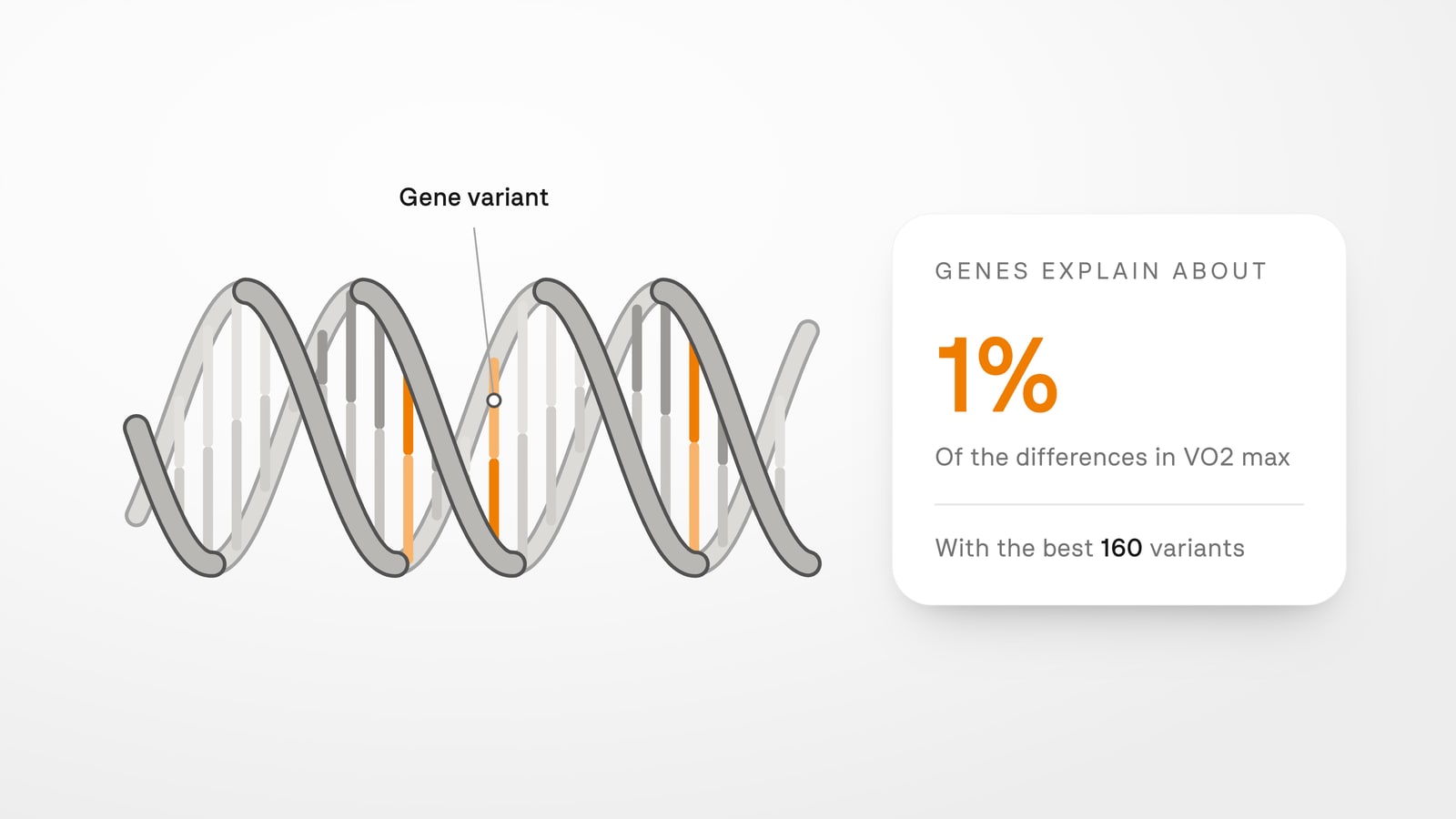
The genes behind that share have mostly not been found. A study of 450,000 adults in UK Biobank found 160 gene variants linked to fitness. Tested in a separate group, all 160 together explained 1.08% of the differences in VO2 max, and the strongest 14 explained 0.54%5. Many of them are genes for resting heart rate and for how heart muscle develops5.
Why VO2 max moves so far, so fast
VO2 max is the blood your heart pumps in a minute multiplied by the oxygen your muscles take out of it6. Every part of that chain is living tissue, and it rebuilds itself to match how hard you use it.
Much of the early gain is in the blood. In 16 untrained young men, 6 weeks of training raised VO2 max by 9%. Their red blood cell volume rose 8%, the capillaries around each muscle fibre 18% and their mitochondria 43%. When the researchers then took the extra red blood cells back out, VO2 max fell to where it had started7.
The heart changes just as quickly. In the Dallas men, almost all of the change came from how much blood the heart pumped with each beat, while their heart rate and the oxygen their muscles extracted barely moved1. Thirty years later, at 50, their VO2 max was 2.9 L/min. At 60 it was 2.4, the same as after 3 weeks in bed at 201.
3 weeks in bed cost these men as much VO2 max as 40 years of ageing
VO2 max (L/min)
| Age 20 | 3.3 |
|---|---|
| Age 20, after 3 weeks of bed rest | 2.4 |
| Age 20, after 8 weeks of training | 3.9 |
| Age 50 | 2.9 |
| Age 50, after training | 3.3 |
| Age 60 | 2.4 |
So your VO2 max mostly reflects how hard you've used your heart and blood in recent weeks, whatever level your genes started you at.
Why some people seem not to respond
Genes do change how much a given amount of training does for you. In HERITAGE's training study, 481 inactive adults followed the same 20 week programme. VO2 max rose by about 400 mL/min on average, but some people gained little or nothing and others more than 1 L/min. About 47% of that spread ran in families8. That spread is where the idea of the "non-responder" comes from.
A 2017 trial found that most non-responders hadn't trained enough. 78 untrained young men cycled for 6 weeks in 60 minute sessions, mostly at a steady 65% of the peak power from their first test, with interval days mixed in. Each man chose how many sessions a week to do, from one to five. At 60 minutes a week, 69% didn't improve their peak power. At 240 minutes or more, none failed9.
Nobody training 240 minutes a week failed to improve
Share who didn't improve after 6 weeks (%)
| 60 min a week | 69% |
|---|---|
| 120 min a week | 40% |
| 180 min a week | 29% |
| 240 min a week | 0% |
| 300 min a week | 0% |
The men who hadn't improved then trained for another 6 weeks with two extra 60 minute sessions a week, and every one of them improved. Their gains came through VO2 max, and the biggest single factor in VO2 max was how much haemoglobin their blood carried9.
Genes changed how much each hour of training bought, but they didn't stop anyone improving once the hours went up. The trial was in young men who chose their own dose, so the finding may not hold for everyone.
What a genetic study of lifespan missed
In 2025, a genetic study concluded that VO2 max doesn't make you live longer. It took the gene variants linked to VO2 max in about 70,000 UK Biobank adults, whose VO2 max had been estimated from a bike test. It found those variants were no more common in people whose parents lived longer, across about a million parents10.
That method only tells you what an intervention will do if the genes change the trait the way the intervention would. George Davey Smith, one of the epidemiologists who built the method, calls this gene-environment equivalence11. For VO2 max it doesn't hold. The variants nudge VO2 max by a sliver from conception, while training moved it from 2.4 to 3.9 L/min in 8 weeks through the heart and the blood. The study could only test the sliver.
Whether a VO2 max you build adds years is still open. In the longest trial, Generation 100, 1,567 Norwegians aged 70 to 77 trained for 5 years, and deaths didn't clearly differ from those who followed the usual activity advice12.
What to do with this
Give training the dose before you decide your genes are the limit. In the 2017 trial, nobody who trained 240 minutes a week for 6 weeks failed to improve, against 69% of those who trained 60 minutes9. That's four 60 minute sessions a week, most at a steady effort around 65% of the peak power from a test, with an interval day or two. Test before you start and again at 6 weeks. If nothing has moved on less than that, add two 60 minute sessions a week for another 6 weeks before you call yourself a low responder.
Don't pay for a DNA test that claims to read your VO2 max potential. The best genetic scores explain about 1% of the differences between people5. Your own test result, measured twice 6 weeks apart, tells you far more.
How we help
Every man in the 2017 trial who didn't improve did once he trained more, and two tests 6 weeks apart were what showed who needed the extra hours. We help you run the same check on yourself.
Stride, our VO2 max test, measures your VO2 max from the air you breathe on a treadmill or bike as you build to your maximum, the way the Dallas men were tested. A test before you start and another 6 weeks later tell you whether you're responding. Say you train 120 minutes a week and your VO2 max reads 32 mL/kg/min both times. That puts you with the 40% of the trial who hadn't improved at that dose, and their fix was two more 60 minute sessions a week9.
The same test scores your heart, lungs and muscles and names the one that capped your VO2 max. Archie, our AI exercise physiologist, builds your week around it and marks the sessions that train that part of the chain. It sets your heart rate zones from your own thresholds rather than your age, and adjusts the plan after every session.
You can book a test in Manchester or London, or meet Archie.
Find out your real number
from £169A watch or a formula gives you a range. Stride measures your VO2 max, and Scan measures your fat, muscle and bone.
Citations
-
Mitchell JH, Levine BD, McGuire DK. The Dallas Bed Rest and Training Study: revisited after 50 years. Circulation. 2019;140(16):1293-1295.
-
McGavock JM, Hastings JL, Snell PG, et al. A forty-year follow-up of the Dallas Bed Rest and Training study: the effect of age on the cardiovascular response to exercise in men. J Gerontol A Biol Sci Med Sci. 2009;64(2):293-299.
-
Bouchard C, Daw EW, Rice T, et al. Familial resemblance for VO2max in the sedentary state: the HERITAGE family study. Med Sci Sports Exerc. 1998;30(2):252-258.
-
Hanscombe KB, Persyn E, Traylor M, et al. The genetic case for cardiorespiratory fitness as a clinical vital sign and the routine prescription of physical activity in healthcare. Genome Med. 2021;13(1):180.
-
Cai L, Gonzales T, Wheeler E, et al. Causal associations between cardiorespiratory fitness and type 2 diabetes. Nat Commun. 2023;14(1):3904.
-
Bassett DR, Howley ET. Limiting factors for maximum oxygen uptake and determinants of endurance performance. Med Sci Sports Exerc. 2000;32(1):70-84.
-
Montero D, Cathomen A, Jacobs RA, et al. Haematological rather than skeletal muscle adaptations contribute to the increase in peak oxygen uptake induced by moderate endurance training. J Physiol. 2015;593(20):4677-4688.
-
Bouchard C, An P, Rice T, et al. Familial aggregation of VO2max response to exercise training: results from the HERITAGE Family Study. J Appl Physiol. 1999;87(3):1003-1008.
-
Montero D, Lundby C. Refuting the myth of non-response to exercise training: non-responders do respond to higher dose of training. J Physiol. 2017;595(11):3377-3387.
-
Kjaergaard AD, Ellervik C, Jessen N, Lessard SJ. Cardiorespiratory fitness, body composition, diabetes, and longevity: a 2-sample Mendelian randomization study. J Clin Endocrinol Metab. 2025;110(5):1451-1459.
-
Davey Smith G, Hemani G, Ebrahim S. Gene-environment equivalence: the fundamental principle of Mendelian randomization. PLoS Med. 2026;23(3):e1005013.
-
Stensvold D, Viken H, Steinshamn SL, et al. Effect of exercise training for five years on all cause mortality in older adults (the Generation 100 study): randomised controlled trial. BMJ. 2020;371:m3485.
How this article was reviewed
Medically reviewed by Dr Jack Close, last on . Every SPN Health article goes through three steps before it is published.
- Research checked against its source. Every number is matched to the paper it came from, and each study is weighed by its design, its size and power, who was studied, and where it was published.
- Findings matched to the physiology. Each finding is explained by what happens in the body, in health and in disease. A result that doesn't fit is explained or left out.
- Medical review by Dr Jack Close. A check that the article is clinically relevant and safe for the people reading it, and that its advice is something you can act on day to day.
This article explains the research and isn't personal medical advice. Speak to your doctor before making changes if you have a medical condition or take regular medication.